Most people call about a tree only when something has already gone wrong. A limb over the driveway that’s clearly dying. A trunk that’s started leaning after a windy week. A stump that’s been sitting there since last spring. What gets missed in that reactive pattern is how much of what arborist companies in Ottawa actually do happens well before any of that becomes urgent.
This article covers the full range of services an arborist provides, what separates that work from general tree cutting, and what to look for when hiring in Ottawa specifically.
What an Arborist Actually Is
Worth clearing this up first, because the terms get used interchangeably and they genuinely aren’t the same thing.
An arborist is a professional who is trained to grow, manage and care for trees. The common credential is certification from the International Society of Arboriculture. This certification shows that the arborist knows about tree biology, diagnosis, soil science, pruning standards and safe work practices. It also requires education to keep the certification.
A general tree service may be very good at cutting and removing trees. It may not have formal training, in tree health, disease identification or pruning standards that decide if a tree survives a job in good condition. Both have their place. The distinction matters most when the goal is to keep a tree alive and healthy not to get it down.
Tree Health Assessment and Diagnosis
This is the service that separates arborist work most clearly from cutting-focused operations, and it’s frequently the reason someone calls in the first place.
A certified arborist in Ottawa assessing a tree looks at crown condition, leaf colour and density, bark integrity, root flare visibility, evidence of fungal bodies, and signs of insect activity. From that assessment comes a diagnosis and a recommendation, which might be treatment, might be structural pruning, might be removal, and sometimes is simply monitoring over a growing season before acting.
Ottawa has a diagnostic context that matters here. Emerald ash borer has moved through Eastern Ontario ash populations over the past decade and a half. Identifying an ash early enough to consider treatment versus removal is a significantly different outcome than discovering Emerald ash borer after the tree has already declined past saving. Signs include thinning canopy, D‑shaped exit holes in bark and increased woodpecker activity as birds feed on larvae under the bark.
Pruning and Structural Work
Pruning is probably the most requested service and also the one most commonly done badly by unqualified operators.
Proper pruning follows established standards around cut placement, how much of a canopy can safely be removed at once, and which branches to target for structural improvement rather than just clearance. Cuts made in the wrong place, particularly flush cuts that remove the branch collar, damage the tree’s ability to compartmentalize the wound and invite decay.
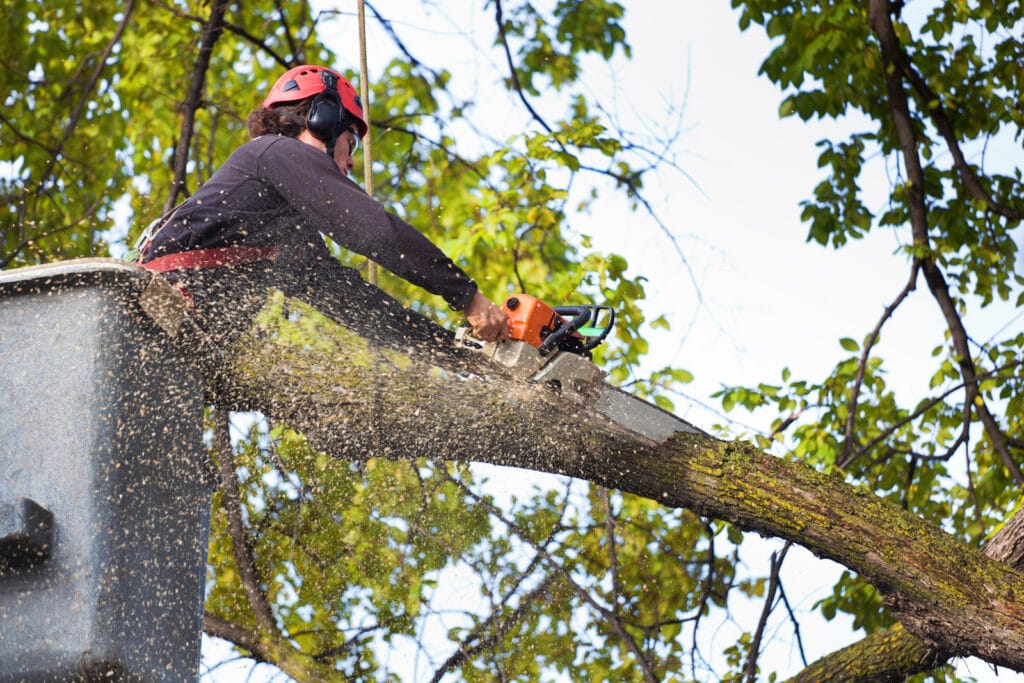
An arborist in Ottawa who prunes trees usually deals with types of work depending on what the owner wants. Crown cleaning removes diseased or broken branches. Crown thinning cuts down density so that light can reach the parts of the tree and reduces wind resistance, a very important factor when ice and storms weigh on the branches. Crown raising lifts the canopy to give enough clearance above walkways or driveways. Structural pruning on trees builds a strong branch structure early which stops the need for much larger expenses fifteen years later.
Tree Removal and Stump Grinding
Not every tree can be. A good arborist will say so directly rather than recommending indefinite treatment on something that is structurally compromised.
Removal decisions typically come down to whether the tree poses a risk, whether the tree has declined past recovery or whether the tree is in a location where the structure simply cannot remain. The work itself for large trees near buildings or power lines involves rigging, sectional dismantling and controlled lowering rather than simply felling a trunk in one piece.
Stump grinding usually follows removal as a step because the remaining stump becomes a trip hazard, a pest habitat and an obstacle to replanting or landscaping.
Worth knowing that Ottawa has a tree protection bylaw regulating the removal of certain trees on private property based on trunk diameter, and permits may be required depending on the tree’s size and location. A reputable company will know whether a specific removal falls under those requirements rather than leaving the property owner to discover it afterward.
Emergency and Storm Response
Ottawa’s winters produce ice loading that reliably brings down branches, and occasionally entire trees, across the region. Storm response is a distinct service category because it involves hazardous conditions, often unstable material under tension, and frequent proximity to power lines or damaged structures.
This is genuinely not work to attempt independently. A branch under load can release unpredictably, and trees leaning against structures after failure carry compression forces that aren’t obvious from the ground. Companies offering emergency response typically prioritize hazard removal first, with cleanup and assessment of remaining trees following once the immediate danger is addressed.
Planting Consultation and Young Tree Care
The least dramatic service arborist companies offer and arguably the one with the longest-term payoff.
Species selection for Ottawa conditions means choosing trees rated for the local hardiness zone that can handle the temperature swings, and considering mature size relative to available space, proximity to foundations and underground utilities, and soil conditions on the specific site. A tree planted in the wrong location becomes a problem that compounds every year it grows.
Young tree care, particularly formative pruning during the first several years, shapes branch structure in ways that reduce failure risk decades later. It’s inexpensive work at that stage and considerably more expensive to correct once a poor structure is established in a mature tree.
How to Choose an Arborist Company in Ottawa
A few things genuinely separate a qualified operation from one worth avoiding.
ISA certification is verifiable directly through the organization’s public credential lookup, and asking for a certification number is a reasonable request rather than an imposition. Liability insurance and WSIB coverage matter substantially given the risk profile of the work and the proximity to structures on most residential jobs. Written estimates that specify scope prevent disputes over what was actually agreed.
Local experience counts for more than people expect. A company working in Ottawa regularly knows the municipal bylaw requirements, recognizes regional pest and disease patterns on sight, and understands how ice loading affects branch failure here specifically.
Arborist companies in Ottawa cover considerably more ground than tree removal, spanning diagnosis, pruning to recognized standards, emergency response, planting guidance, and long-term care planning. Knowing that scope makes it easier to ask the right questions and to recognize when a quote reflects genuine expertise rather than just equipment and labour.
FAQs
How do you choose an arborist company in Ottawa?
Check ISA certification using the organization’s public search tool. Make sure the company has liability insurance and WSIB coverage. Ask for a written estimate that lists the scope of work. Local experience is also important. Ottawa companies understand bylaw rules. They also know about problems such as emerald ash borer, which operators from outside the area may overlook.
How do you find a certified arborist in Ottawa?
The International Society of Arboriculture has a list of certified professionals by place. You can ask a company for its ISA certification number. Check it on your own. This is quick and only takes a minute. ISA certification proves that the worker has training in tree biology and pruning standards, not just experience with cutting.
What's the difference between an arborist and a general tree service?
An arborist has training in tree health, diagnosis, soil science and pruning standards. This training is usually shown by ISA certification. A general tree service can. Remove trees well but it may not have that specialized background. That background matters most when the goal is to keep a tree instead of taking it away.
Do arborist companies in Ottawa handle tree removal permits?
Reputable companies know whether a specific removal falls under Ottawa's tree protection bylaw, which regulates removal of certain private property trees based on trunk diameter. Many will advise on permit requirements and assist with the process, though confirming this upfront is worthwhile before scheduling work.
